


Safety and Security While Job Hunting: Protecting Yourself from Maritime Job Scams
 CrewBase Team
Job hunting can be exciting, but for maritime professionals, it also comes with significant risks. Every year, hundreds of seafarers fall victim to sophisticated scams that steal personal documents, drain bank accounts, or worse—compromise their safety and professional reputation.
One well-known case in the industry involved a second officer who joined a vessel with a complete set of documents—certificates, passport, medical papers. Everything appeared legitimate. Until the crew discovered that the documents, while valid, belonged to someone else entirely. He had purchased a full identity package from a black-market dealer. The officer was dismissed immediately and blacklisted; the real document owner spent months in legal proceedings to reclaim his identity and clear his name from flag-state databases.
Cases like this are far from rare. In 2019, the International Transport Workers' Federation (ITF) documented dozens of incidents where seafarers from Southeast Asia responded to seemingly legitimate job postings on social media—only to find themselves on illegal fishing vessels off the coast of West Africa, with their passports confiscated and wages withheld for months. Some were unable to contact their families. These recruitment operations ran through fake manning agencies with professional-looking websites that disappeared overnight once enough victims had been collected.
This article will show you how to protect yourself from job scams, recognize red flags, and understand why security matters more than speed when searching for maritime work.
🚨 Never Do This: Critical Security Rules
Let's start with the absolute no-go zone—actions that put you at immediate risk.
- Full scans of your documents (passport, certificates, seaman's book) with photos and ID numbers visible—especially to unverified contacts
- Personal contact details in public listings or open forums (mobile number, home address)
- Your complete resume in unrestricted public access—makes it easy for scammers to clone your identity
- Banking or payment information before signing a verified contract
- Login credentials for job platforms or email accounts—legitimate recruiters will never ask for these
Why recruiters don't need your full documents upfront
A professional recruiter needs only your CV and a brief overview of your certificates (type, issuing authority, expiry dates—not scans). If they immediately ask for full document scans before even a preliminary interview, that's a red flag.
Many scammers specifically request "all your documents for verification" as their opening line. This is not standard practice in legitimate maritime recruitment.
🔍 Red Flags: How to Spot a Scam
Fraudulent job postings often follow predictable patterns. Here's how to identify them before it's too late.
1. Suspicious email addresses
If a recruiter contacts you from @gmail.com, @yahoo.com, @hotmail.com, or similar free email services, be immediately cautious. Legitimate maritime companies use corporate email domains (e.g., recruiter@maerskcrewing.com, hr@teekay.com).
Always verify the company's official website and cross-check email addresses. If the domain doesn't match the company name, it's likely a scam.
2. No company information or vague details
Scam postings typically lack:
- Company name or use generic names like "International Shipping Company"
- Specific vessel details—type, flag, route, owner
- Detailed job requirements—just "All positions available!"
- Contact verification—no phone number, office address, or website
If a posting says "We need entire crew immediately" or "All ranks available," that's a mass-mailing scam designed to harvest applications.
3. Links without preview or context
Never click suspicious links sent via email or messaging apps without verifying the sender. Check for:
- URL preview (hover over the link before clicking)
- Shortened URLs (bit.ly, tinyurl) without explanation
- Mismatched domains (e.g., "maersk-recruiting.su" instead of "maersk.com")
4. Too-good-to-be-true conditions
If a job posting offers:
- Salaries 50%+ above market rate with no experience required
- Immediate joining with no interview or document verification process
- Guaranteed contracts without any qualification checks
- Payment or fees upfront for "processing" or "fast-track approval"
...it's almost certainly a scam.
5. Mass email indicators
Check the email header. If you see "Undisclosed recipients" or a long list of BCC'd emails, you're receiving a mass spam message—not a personalized recruitment offer.
"If the email wasn't sent specifically to you, the job offer isn't meant specifically for you."
📸 Real Examples: What Scam Postings Look Like
Here are actual examples of scam job postings circulating on social media and job boards. Notice the red flags we discussed above:
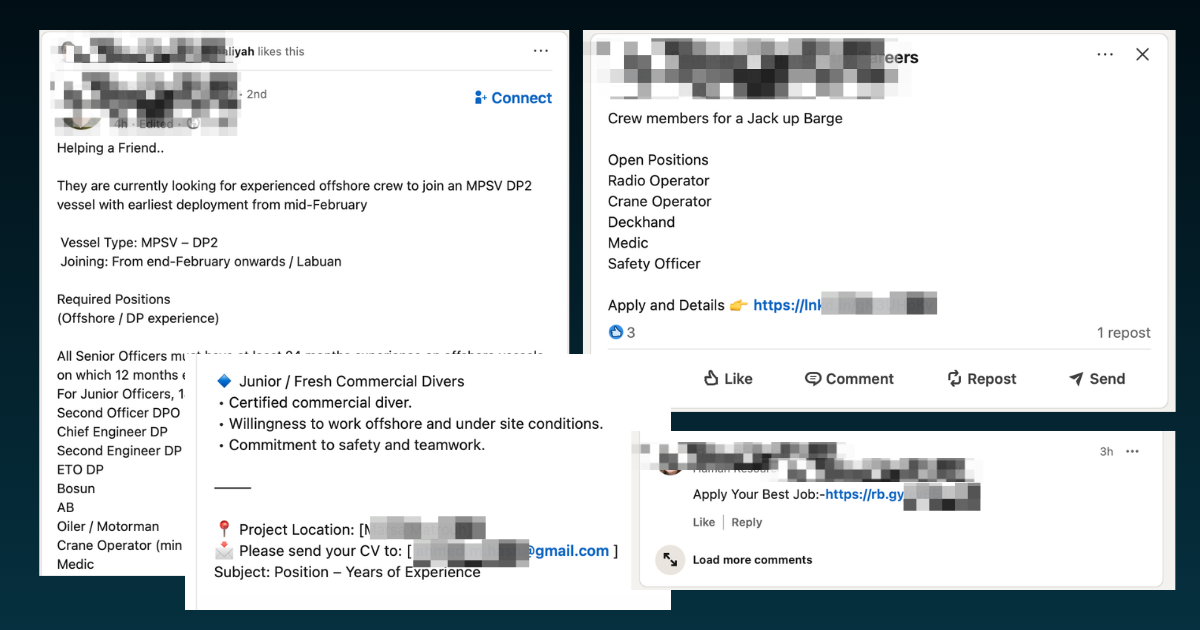
- No link preview — Suspicious shortened URLs or links that don't show company info
- Minimum details — Vague job descriptions like "Crew members for a Jack up Barge" without specifics
- No company name — Generic posts like "Helping a Friend" or contact via personal profiles
- Mass distribution — Same message posted across multiple platforms simultaneously
- Pressure tactics — "Apply immediately" or "Limited spots available" to rush your decision
Compare this to legitimate job postings which include: verified company name, detailed vessel specifications, clear job requirements, corporate email address, and transparent application process.
⚠️ The Real Consequences of Job Scams
Maritime job scams aren't just annoying spam—they have serious, life-altering consequences.
Identity theft and document fraud
Once scammers have your documents, they can:
- Create fake profiles to apply for jobs under your name
- Sell your documents on the dark web to unqualified individuals who use them to board vessels under false identities
- Open bank accounts or take loans in your name
- Blackmail you by threatening to report falsified applications you never made
The real owner of stolen documents can face years of legal battles, blacklisting by flag states, and destroyed career prospects—even though they did nothing wrong.
Financial losses
Common financial scams include:
- "Processing fees" for visa applications, medical certificates, or contract paperwork (legitimate companies cover these costs)
- "Advance payments" for flights, uniforms, or training that never happen
- Fake recruitment agencies that charge upfront fees and disappear
Victims often lose $500–$5,000 or more with zero recourse.
Malware and phishing attacks
Clicking suspicious links can install malware that:
- Steals passwords and banking credentials
- Monitors your computer activity
- Encrypts your files and demands ransom (ransomware)
Reputational damage
If scammers apply to jobs using your stolen identity and fail background checks, your name gets flagged in industry databases. Clearing your reputation requires extensive documentation, legal support, and can take months or years.
✅ How to Protect Yourself
Follow these best practices to stay safe while job hunting.
1. Verify before you respond
- Google the company name + "scam" to see warnings from other seafarers
- Check the company's official website and verify contact details match
- Look up the recruiter on LinkedIn and confirm their employment history
- Cross-reference vessel names on Equasis, MarineTraffic, or IMO databases
2. Use professional recruitment platforms
Apply through established platforms with verification systems rather than responding to cold emails or social media messages.
3. Send a CV summary, not full documents
Your initial application should include:
- Your CV (without passport numbers or personal IDs)
- Certificate overview (type and validity, not scans)
- Brief cover letter
Share full documents only after a verified interview and contract offer.
4. Trust your instincts
If something feels wrong, it probably is. Don't let urgency ("This position must be filled today!") override your caution.
🛡️ How CrewBase Protects You
At CrewBase, security and authenticity are built into every part of the platform.
- Verified employers only—Every job posting is manually reviewed before publication. If a company doesn't have verifiable credentials, it's rejected.
- Real company contacts—Every email, phone, and website link is validated. No @gmail.com recruiters allowed.
- CV-only applications—You never send document scans directly. Employers see your professional profile and certificate overview, not your personal IDs.
- Direct employer communication—You interact directly with hiring companies, no middlemen or unverified agents.
- Firebase security & encryption—Your data is protected with enterprise-grade security. We encrypt sensitive information both in transit and at rest.
- Zero data selling—We never sell your information to third parties. No ads, no spam brokers.
- Report & flag system—If you encounter a suspicious posting, report it instantly, and our team takes action within 24 hours.
Privacy by design
When you apply for a job on CrewBase, you control exactly what employers see:
- Your professional profile (rank, experience, skills)
- Certificate types and validity dates (not scans)
- Availability and preferred work locations
Your passport, ID numbers, home address, and personal documents remain private until you choose to share them during the official hiring process.
No fake jobs, no spam
Every job posting must include:
- Company name and registration details
- Vessel type and specifications
- Detailed job requirements and responsibilities
- Verified contact information
Mass recruitment messages ("We need entire crew!") are automatically flagged and removed.
📖 Further Reading: The Outlaw Ocean
If you want to understand the full scope of what happens beyond the horizon—far from port authorities and labor inspectors—there is one book every seafarer should read.
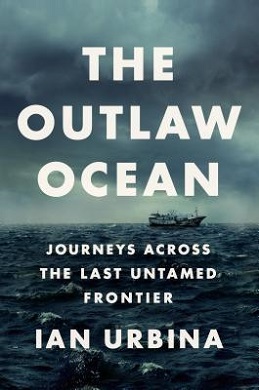
The Outlaw Ocean: Journeys Across the Last Untamed Frontier by investigative journalist Ian Urbina is a deeply reported account of lawlessness at sea. Originally published as a series in The New York Times, the book documents real stories of seafarers who were deceived by fraudulent job postings, lured onto vessels with promises of fair wages, and then trapped—passports confiscated, wages withheld, communications cut off.
Urbina spent years embedded on fishing boats, cargo ships, and floating armories around the world. His reporting covers forced labor on Thai fishing fleets, murder at sea, illegal dumping, and the shadowy networks of recruiters who prey on desperate job seekers through fake manning agencies, spam emails, and social media ads—exactly the kind of scams we describe in this article.
The book is not light reading, but it is essential. It shows, with names, dates, and evidence, what can happen when seafarers trust the wrong recruiter—and why platforms with verified employers and transparent hiring processes matter more than ever.
"The Outlaw Ocean" is available in English, and has been translated into multiple languages. You can find it at major bookstores, on Amazon, or at your local library. Several chapters are also available as free articles on theoutlawocean.com.
Final Thoughts: Security Over Speed
Finding the right job takes time, and that's okay. Your safety, documents, and reputation are worth protecting. A few extra minutes verifying a company can save you years of legal trouble, financial loss, or identity theft.
Remember:
- If they ask for full documents immediately, say no
- If the company has no verifiable online presence, walk away
- If conditions seem too good to be true, they are
- If you feel rushed or pressured, it's a scam
Have you encountered a maritime job scam? Report it to help protect other seafarers. Contact us at support@crewbase.pro or use the in-app report feature.
Stay safe out there, and remember: legitimate opportunities don't require you to compromise your security.
Find verified maritime jobs with CrewBase
Every employer verified. No scams. No spam. Just real jobs from real companies.